
Tag: Business

Thai Work Permit

Thai Work Permit

For foreigners seeking employment in Thailand, obtaining a Thai work permit is a legal requirement. Regardless of the type of work—whether professional, technical, managerial, or even volunteer-based—foreign nationals must secure proper authorization before engaging in any form of employment within the country.

Thailand maintains strict labor and immigration controls to regulate foreign participation in its workforce. These controls are designed to protect local employment opportunities while allowing businesses to benefit from foreign expertise. As a result, the process of obtaining and maintaining a work permit involves multiple legal requirements, coordination with employers, and ongoing compliance obligations.

This article provides a comprehensive and in-depth overview of Thai work permits, including legal foundations, eligibility requirements, application procedures, employer obligations, restrictions, and common challenges.


Legal Framework

Work permits in Thailand are governed by:

  • Foreign Workers Employment Act
  • Immigration Act

These laws regulate:

  • who may work in Thailand
  • types of permissible employment
  • employer responsibilities
  • penalties for non-compliance

A work permit is tied to both the employer and the specific job role, meaning foreigners cannot freely change jobs without updating or reapplying.


What Is a Thai Work Permit?

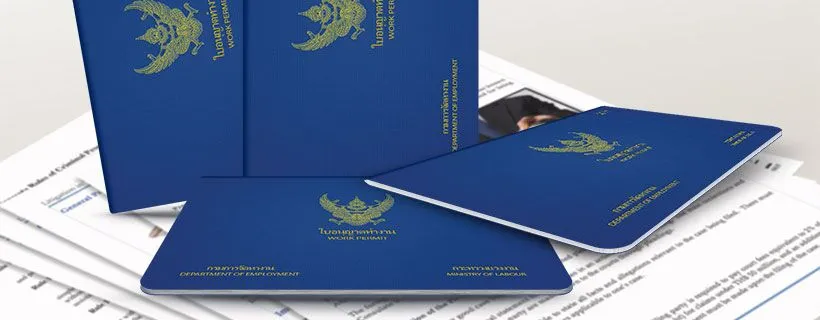
A work permit is an official document issued by the Ministry of Labour that authorizes a foreign national to work legally in Thailand.

Key Features

  • specifies the job position
  • identifies the employer
  • defines the work location
  • limits the scope of permitted activities

Working outside the scope of the permit is considered illegal.


Who Needs a Work Permit?

Any foreigner engaging in work in Thailand must obtain a work permit.

Definition of “Work”

Thai law broadly defines work as:

  • physical or mental activity
  • whether paid or unpaid

This means even volunteer work or informal assistance may require authorization.


Eligibility Requirements

To qualify for a work permit, both the employee and employer must meet specific conditions.


For the Foreign Employee

  • must have a valid Non-Immigrant visa (typically Non-B visa)
  • must possess relevant qualifications or experience
  • must not be engaged in prohibited occupations

For the Employer

The employer must meet financial and operational requirements.

Typical Requirements

  • registered company in Thailand
  • minimum capital requirements (often 2 million THB per foreign employee)
  • appropriate business licenses
  • compliance with Thai labor laws

Restricted Occupations

Thailand reserves certain jobs for Thai nationals.

Examples of Restricted Jobs

  • manual labor
  • retail sales (in many cases)
  • certain service roles
  • agriculture

Foreigners must ensure their job is not on the restricted list.


Application Process


Step 1: Secure a Non-Immigrant Visa

Applicants must first obtain a Non-Immigrant visa, usually from a Thai embassy or consulate.


Step 2: Prepare Documentation

Required documents typically include:

  • passport
  • visa
  • educational certificates
  • employment contract
  • company registration documents
  • medical certificate

Step 3: Submit Application

Applications are submitted to the Ministry of Labour.


Step 4: Approval and Issuance

Once approved:

  • the work permit is issued
  • the employee can legally begin working

Processing Time

Processing times vary but generally range from:

  • a few days to several weeks

Work Permit Conditions

Work permits are highly specific.

Key Restrictions

  • limited to a specific employer
  • limited to a specific job role
  • limited to a specific location

Any changes require official approval.


Changing Jobs or Employers

If a foreigner changes employment:

  • the existing work permit must be canceled
  • a new application must be submitted

Failure to update the permit can result in penalties.


Renewal of Work Permit

Work permits are typically issued for:

  • 1 year (aligned with visa validity)

Renewal Requirements

  • continued employment
  • updated documentation
  • compliance with all regulations

Employer Responsibilities

Employers play a critical role in maintaining compliance.

Key Obligations

  • ensure employee has a valid work permit
  • report employment changes
  • maintain company compliance
  • assist with visa and permit renewals

Employee Responsibilities

Foreign workers must:

  • carry their work permit
  • perform only authorized duties
  • comply with visa conditions
  • report changes in employment status

Penalties for Non-Compliance

Violating work permit laws can result in:

For Employees

  • fines
  • imprisonment
  • deportation
  • blacklisting

For Employers

  • fines
  • business penalties
  • suspension of operations

Special Cases


Board of Investment (BOI) Companies

Companies promoted by the Board of Investment may receive:

  • simplified work permit procedures
  • reduced restrictions
  • faster processing

Short-Term Work Permits

Temporary work permits may be issued for:

  • short-term assignments
  • urgent business activities

Digital Work Permit (Smart Visa)

Thailand has introduced alternative systems for certain professionals, allowing:

  • combined visa and work authorization
  • fewer administrative requirements

Common Challenges


1. Complex Documentation

Incomplete paperwork can delay approval.


2. Changing Regulations

Immigration and labor rules may change.


3. Employer Compliance Issues

Non-compliant companies may affect employee applications.


4. Misunderstanding Work Scope

Performing unauthorized tasks can lead to violations.


Best Practices

To ensure compliance:

  • secure the correct visa before applying
  • verify job eligibility
  • maintain complete documentation
  • update permits when changing roles
  • work with experienced legal professionals

Advantages of a Thai Work Permit

  • legal authorization to work
  • access to employment opportunities
  • ability to stay long-term
  • compliance with Thai law

Limitations

  • restricted job roles
  • dependency on employer
  • administrative requirements
  • need for renewals

Conclusion

A Thai work permit is an essential legal requirement for foreigners seeking employment in Thailand. Governed by the Foreign Workers Employment Act and immigration regulations, the system ensures that foreign labor is properly regulated and aligned with national interests.

While the process involves multiple steps and strict requirements, it provides a clear pathway for legal employment. Both employers and employees must understand their responsibilities to maintain compliance and avoid penalties.

With proper preparation, documentation, and adherence to legal requirements, obtaining a Thai work permit can open the door to professional opportunities and long-term residence in Thailand.


Mergers and Acquisitions in Thailand

Mergers and Acquisitions in Thailand

Mergers and Acquisitions in Thailand. Thailand remains a highly active market for strategic and financial M&A — attractive for its manufacturing base, regional hub status and growing tech and services sectors. But deals must be structured around a complex regulatory landscape: foreign-ownership limits, takeover rules for listed targets, merger control, sectoral regulators and tax/labour traps. This guide explains the legal framework, typical deal structures, regulatory clearances, due diligence priorities and practical structuring choices you’ll face on an M&A in Thailand.

1. Legal and regulatory framework (what governs deals)

Key laws and regulators to keep in mind:

  • Civil & Commercial Code / Companies Act — company law and shareholder mechanics.

  • Foreign Business Act (FBA) — principal source of foreign-ownership restrictions with “lists” of reserved or restricted activities. Foreigners must check whether proposed control is permitted or requires a Foreign Business License or other exemption.

  • Securities & Exchange Commission (SEC) / Stock Exchange of Thailand (SET) — takeover regime and mandatory tender-offer obligations for listed targets.

  • Trade Competition Commission of Thailand (TCCT) — merger control under the Trade Competition Act (pre-merger approval where a merger may create a monopoly; post-merger notification where competition may be substantially lessened).

  • Sector regulators (Bank of Thailand, OIE, OIEA, Energy Regulator, etc.) — industry licenses and approvals for regulated sectors.

These overlapping regimes determine not just the permissibility of a deal but also its timing, conditions and required filings.

2. Typical deal structures — pros and cons

Two principal economic structures are used in Thailand:

A. Share acquisition (buying the company’s shares)

  • Pros: preserves contracts, licenses and permits that are tied to the legal entity; simpler transfer of employees and existing commercial relationships.

  • Cons: buyer inherits all liabilities (litigation, tax, undisclosed debts); may trigger SEC mandatory tender-offer rules if thresholds are crossed (see below).

B. Asset acquisition (buying assets/business lines)

  • Pros: buyer cherry-picks assets and limits legacy liabilities; easier to carve out non-core elements.

  • Cons: requires novation/consent for customer contracts, re-licensing, employee transfers (with consent) and repeated registrations (land transfers attract transfer taxes).

Choice depends on licenses, the target’s license transferability, tax profile and commercial continuity needs.

3. Takeover rules for listed companies

Thailand operates a tender-offer regime. A mandatory tender offer is triggered when a person/entity acquires or passes statutory thresholds of voting rights (notably 25%, 50% or 75% thresholds used as regulatory triggers), and the acquirer must file the prescribed SEC forms and make the offer in the prescribed manner. The SEC’s takeover rules require careful procedural compliance (disclosure, timetable, minimum offer price rules and filing of tender documents).

In practice this means active bidders must plan disclosure timing, financing and possible compulsory buy-outs well in advance — failing to observe SEC thresholds can expose the bidder to fines and forced remedies.

4. Competition (merger control)

Under Thailand’s Trade Competition Act, transactions that may substantially lessen competition must be notified — in some cases prior approval is required where a merger creates a monopoly or dominant position; otherwise a post-merger notification must be filed promptly (often within seven days). The TCCT reviews substantive competition effects and can require remedies. The TCCT and its staff typically take several weeks to months to assess complex cases; for a pre-clearance application, statutory decision windows apply (and extensions are possible).

5. Foreign ownership, exemptions and BOI

The FBA remains the main constraint on foreign control in many service and trading activities. Workarounds or lawful exemptions include: Board of Investment (BOI) promotion (which can permit 100% foreign ownership for promoted activities), qualifying for certain treaties or obtaining a Foreign Business License in limited circumstances. For projects that rely on full foreign ownership, applying for BOI promotion is a routine structuring option since BOI status may also provide tax incentives and simpler work-permit/visa processing.

6. Due diligence — what buyers should focus on

A Thailand M&A due diligence must be thorough and locally grounded. Core workstreams:

  • Corporate and shareholder due diligence: confirm share chain, shareholder agreements, power of attorney, beneficial ownership and any nominee issues.

  • Regulatory & license checks: identify licenses that will be lost on a change of control (and whether they are transferable).

  • Tax & customs: historical tax exposures, transfer pricing, VAT liabilities, and stamp duty implications for share vs asset deals.

  • Land and property: verify title deed type (chanote vs lesser documents), encumbrances and any land-use restrictions.

  • Employment & labour: identify collective agreements, severance exposure and statutory entitlements that attach on termination or transfer.

  • Contracts & change-of-control clauses: customers, suppliers, IP licenses and loan covenants that permit termination on change of control.

  • Litigation & contingent liabilities: pending suits, regulatory investigations, environmental liabilities.

Each diligence track typically generates closing conditions, indemnities, escrow mechanics and warranty caps in the SPA.

7. Tax, timing and implementation issues

Tax treatment materially affects structure: share sales generally incur stamp duty (and capital gains may be taxable at corporate or personal level depending on seller status), while asset transfers can expose a seller to specific business tax, VAT and land transfer fees. Buyers should model cash flow and post-closing taxes early, and consider using escrow or holdback to address tax uncertainty.

Typical transaction timeline: due diligence (2–6 weeks), negotiation & signing (2–4 weeks), regulatory approvals (varies — weeks to many months). Sectoral and competition approvals are usually the critical path.

8. Common pitfalls & practical advice

  • Underestimating the FBA: confirm whether the target’s business is in a restricted list and plan BOI/FBL or alternative structures early.

  • Surprise SEC obligations: crossing tender-offer thresholds without pre-planning can derail deals.

  • Assuming licenses transfer: many Thai licenses are entity-specific; where continuity matters, a share deal or pre-approval may be required.

  • Competition clearance timing: don’t close before clearance where pre-merger approval is required; post-notification remedies can be burdensome.

9. Dispute resolution and remedies

Parties commonly opt for arbitration (SIAC, ICC or Thai Arbitration Institute) for commercial certainty and enforceability across borders; however, some remedies (urgent injunctive relief or registrar filings) require access to Thai courts. Draft warranty and indemnity clauses carefully; escrow, retention and insurance (representation & warranty insurance) are frequently deployed to allocate risk.

10. Practical checklist (closing essentials)

  • Confirm whether deal triggers mandatory tender offer and prepare SEC filings.

  • Assess competition notification/pre-clearance needs and timetable.

  • Verify foreign ownership limits and whether BOI or FBL is needed; if BOI is intended, start early.

  • Complete tax modelling for share vs asset purchase and build escrow/holdback accordingly.

  • Prepare employee and transfer-of-license plans; secure consents needed for contract novation.

  • Agree dispute resolution forum and secure interim relief routes (Thai courts/arbitral seat).

Conclusion

M&A in Thailand delivers strategic access to ASEAN supply chains and local markets, but success depends on early regulatory mapping (FBA/BOI, SEC tender rules, TCCT merger control), focused local due diligence and tax/labour planning. For cross-border buyers, combining experienced local counsel with financial and competition advisers is essential to de-risk timing, approval risk and post-closing liabilities.